Metal Coating Services: Functional Metal Coatings for Industrial Applications at Buser

In industrial applications, metal components often need to perform far beyond what the base material alone can provide. Corrosion, wear, aggressive chemicals, high temperatures, or unwanted friction can significantly impair service life and functionality. By applying a targeted coating to metal, surfaces can be protected while simultaneously being endowed with additional functional properties.
At Buser Oberflächentechnik, we coat metal components with various plastics, metals, cermets, and ceramics. The most suitable coating system depends not only on the base material but, above all, on the requirements of the component’s intended use.
Why coat metal?
A metal coating can specifically improve a component’s properties exactly where they’re needed: on its surface. For example, the base material continues to provide stability and strength, while the coating takes on additional protective or functional properties.
Depending on the coating material and process, the following objectives—among others—can be achieved:
- Corrosion protection against moisture, aggressive media, and environmental influences
- Wear protection for surfaces subjected to high mechanical stress
- Greater resistance to chemicals
- Improved non-stick and sliding properties
- Electrical or thermal insulation
- Defined surface roughness, grip, or slip resistance
- Protection against erosion and cavitation
- Restoration of worn surfaces and dimensional corrections
When coating metals, therefore, it is less a matter of finding a universally best process than of selecting the right combination of base material, coating material, pretreatment, and operating conditions.
Which coatings are suitable for metal?
The term “metal coating” is not synonymous with a metallic coating. It can also mean that a metallic component is coated with, for example, plastic or ceramic.
At Buser, we offer a variety of processes and coating materials. This allows us to tailor the surface properties specifically to the respective application.
Plastic Coatings for Metal
A plastic coating on metal can do far more than simply serve as a decorative surface finish. High-performance engineering plastics enable functional coatings with precisely defined properties.
Depending on the application, materials such as fluoropolymers and engineering plastics—including PTFE, PFA, FEP, ECTFE, ETFE, PEEK, PEKK, PE, and PVDF—may be used. These can be used to create surfaces that are, for example, chemical-resistant, corrosion-resistant, lubricious, non-stick, or electrically insulating.
Depending on the material and the desired coating properties, we use different processes. For more information, see our sections on liquid coatings and powder coatings.
Metal, Cemented Carbide, and Ceramic Coatings via Thermal Spraying
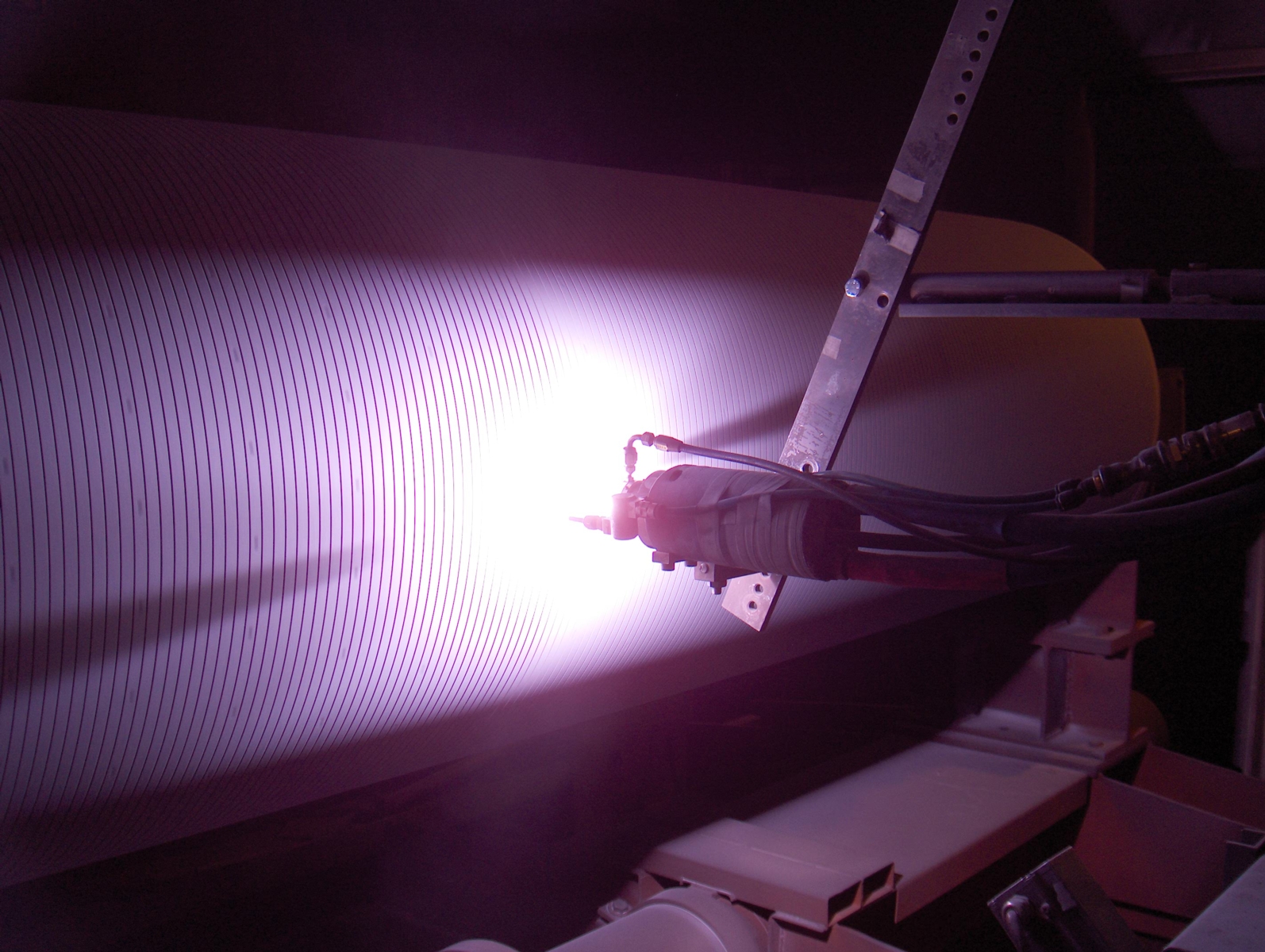
Thermal spraying offers particularly versatile options for functional surfaces subject to heavy wear. Depending on the requirements, metallic components can be coated with metals, cermets, or ceramics.
The processes used at Buser include, among others, HVOF, plasma, wire arc, wire flame, and powder flame spraying.
For particularly demanding applications, different coating properties can also be combined. With such composite coatings, for example, a hard wear-resistant layer can be supplemented with an additional lubricating or non-stick function.
What function should the metal coating fulfill?
Selecting a suitable surface coating for metal always begins with the question of what function the surface must fulfill in its subsequent application.
- Corrosion protection: Metallic components can be protected from moisture, aggressive media, and corrosive process conditions using suitable polymer, metal, or specialty coatings.
- Wear protection: In cases of high friction, abrasive stress, or mechanical stress, hard metal, cemented carbide, or ceramic coatings can significantly increase a component’s service life.
- Chemical resistance: High-performance plastics, such as certain fluoropolymers, are suitable for protection against aggressive chemicals, depending on the medium and temperature.
- Non-stick properties and lubricity: Coatings can reduce adhesion, influence the coefficient of friction, and improve motion. This is relevant, for example, for production, guide, and transport components.
- Electrical insulation: Certain plastic and ceramic coatings can electrically insulate metallic surfaces.
- Thermal functions: Depending on the coating structure, the thermal properties of a surface can also be specifically influenced.
- Roughness and grip: Not every application requires the smoothest possible surface. For transport, drive, or guidance tasks, a surface with targeted grip can be crucial.
Therefore, the overall application is always the deciding factor. A coating that, for example, offers particularly good non-stick properties is not automatically the best solution for maximum wear resistance or exposure to harsh chemicals.
Anti-slip Coating for Metal
A defined level of grip may be required on metal rollers, cylinders, guides, or other contact surfaces. A suitable anti-slip coating for metal improves force transmission and reduces unwanted slippage between the component and the material.
For such applications, Buser offers, among other things, polyurethane elastomer coatings. Depending on their design, these can be used to increase the grip of metal surfaces.
In addition, such coatings can provide protection against wear, corrosion, erosion, or cavitation. The appropriate surface texture and coating structure depend on the required adhesion, the forces involved, and the specific environmental conditions.
Food-Grade Coatings for Metal
Components used in the production, processing, or packaging of food impose special requirements on the coating materials used.
A food-safe coating for metal must therefore be specifically selected for the intended contact and the corresponding operating conditions. Not every technically suitable plastic or metal coating is automatically intended for food contact.
Buser offers various coating systems that, depending on the specific design, meet the requirements for food contact or may have the appropriate FDA or EU approvals. These include, for example, selected systems based on fluoropolymers and other high-performance plastics.
The choice of coating depends, among other factors, on:
- Type of food or process medium
- Direct or indirect contact
- Temperature
- Cleaning and disinfection procedures
- Mechanical stress
- Required non-stick or lubricating properties
For more information on relevant systems, please see our food-grade coatings.
Which metals can be coated?
Many industrial metals can be coated with functional coatings. These include, in particular:
- Steel
- Stainless steel
- Aluminum
- Other metallic materials, depending on the selected process
However, which metal coating is technically suitable must be determined for the specific material combination. In addition to the base material, its surface condition, thermal resistance, component geometry, and the required adhesion strength play a particularly important role.
Pre-treatment is also crucial. A high-performance coating begins with a properly prepared surface.
How We Find the Right Metal Coating
To ensure a reliable coating, we consider not only the component itself but the entire application scenario.
The most important selection criteria include:
- Base material: Which metal is to be coated?
- Desired function: Is the goal, for example, corrosion protection, wear protection, non-stick properties, or insulation?
- Mechanical stress: What types of friction, abrasion, or impact is the surface exposed to?
- Chemical stress: What substances does the component come into contact with?
- Temperature: What sustained and peak temperatures occur during operation?
- Friction behavior: Should the surface be particularly slippery or intentionally non-slip?
- Electrical or thermal requirements: Does the coating need to insulate or meet specific thermal conditions?
- Food or drinking water contact: Are there any special regulatory requirements to consider?
- Component geometry: Which surfaces and contours need to be coated?
- Coating thickness and surface quality: What dimensions, tolerances, and surface roughness values must be met?
Based on these factors, we select the appropriate coating material and process. If necessary, multiple properties can also be combined within a coordinated coating system. The Applications and Functions section also provides an overview of the various functional options.
How does metal coating work?
The exact process depends on the component, coating material, and method. Typically, the coating of metals involves several coordinated steps:
- Analyze the component and requirements: First, the base material, condition, and intended operating conditions are assessed.
- Select the coating system: The coating material and process are determined based on the requirements.
- Prepare the surface: The component is cleaned and, depending on the process, is sandblasted or otherwise pretreated.
- Remove existing coatings: For repair or recoating, old or damaged layers are professionally removed as needed.
- Apply the coating: The selected material is applied using the specified process.
- Finishing the coating: Depending on the process, polymer systems are, for example, cured or sintered. In thermal spraying, the functional layer is formed during the spraying process itself.
- Surface finishing: If technically necessary, coated surfaces can be mechanically machined to defined dimensions or surface qualities.
- Quality inspection: Finally, the relevant properties of the coating are checked.
The coordinated overall process results not only in a coated surface but also in a functional surface finish tailored to the intended application.
Interested?
Testing Metal Coatings and Ensuring Quality
A functional metal coating must reliably and reproducibly achieve the required properties. Quality assurance tailored to the specific coating system is therefore essential.
Depending on the application and coating, the following properties, for example, can be tested:
- Coating thickness
- Adhesion
- Porosity
- Surface quality
- Electrical properties
Test and measurement results can be documented upon request. Information on the available quality certifications can also be found under the certificates section of Buser Oberflächentechnik
Repairing Worn Metal Coatings Instead of Replacing Components
It’s not just new parts that can be coated. Especially for high-quality, large, or hard-to-replace components, it can make economic sense to refurbish existing parts.
Damaged or worn coatings can be removed, depending on their condition, and then rebuilt. Using suitable thermal spraying processes, worn areas can also be rebuilt and dimensional deviations corrected.
Thus, professional recoating can extend the service life of existing components and avoid the need for complete replacement.
We assess whether a repair is technically and economically feasible based on the component’s condition, the base material, the existing coating, and the anticipated future stress.
The optimal surface coating results from the interplay of the base material, coating material, process, and application. That is why we approach each project individually.
Would you like to have metal coated or determine which coating system is suitable for your component? Send us the key details about the component, the base material, and the application. We’d be happy to assist you in selecting a technically suitable coating solution.