Coating Repair: Professional Repair of Functional Coatings
Coatings protect, separate, insulate, improve sliding properties, or prevent media and materials from adhering. If such a surface is damaged, worn, or chemically attacked, the question quickly arises: Does the entire component need to be replaced—or can the coating be repaired?
In many industrial applications, a professional repair is the more economical and sustainable solution. Especially for high-quality components, large parts, custom-made products, or hard-to-find replacement parts, a precisely applied repair layer can help restore the surface’s function and significantly extend the component’s service life.
Buser Oberflächentechnik AG supports companies in analyzing damaged coatings, selecting suitable processes, and professionally refurbishing functional surfaces.
Repair Coatings Instead of Replacing Components
A damaged coating does not automatically mean that the affected component is unusable. Depending on the nature of the damage, the base material, and future stress, the surface can be specifically prepared, rebuilt, or provided with a functional repair layer.
This is particularly worthwhile when the component itself is still intact, but the surface has partially lost its original function. Typical reasons for repair include wear, corrosion, chemical exposure, deposits, mechanical damage, or dimensional loss on stressed functional surfaces.
A professional repair of coatings can help reduce downtime, lower replacement part costs, and conserve resources. However, it is crucial that the repair is not merely superficial. The new layer must be suited to the technical application, the base material, and the subsequent stress it will be subjected to.
When does it make sense to repair a coating?
Whether a coating can be repaired always depends on the specific component and the condition of the surface. Repair is particularly advisable when the component’s underlying structure is still sound and the desired function can be restored by applying a new or supplementary layer.
Repair is often a viable option for components exposed to high mechanical, thermal, or chemical stresses. These include, for example, machine parts, rollers, molds, guides, housings, plant components, components used in power plant maintenance, and functional surfaces in the food, chemical, packaging, and medical technology industries.
Repair can also be economically attractive for large components or those that are difficult to disassemble. In such cases, Buser assesses whether on-site machining is possible or whether a mobile service is a viable option.
However, not every type of damage can be repaired on a spot basis. If the existing coating has been compromised over a large area, is severely worn, or no longer adheres properly, complete removal and recoating may be the better solution. That is why a professional repair always begins with a careful assessment of the damage.
From Damage Analysis to the Right Repair Coating
Before applying a new repair coating, it is essential to determine why the existing coating was damaged. This is the only way to prevent the same damage from recurring shortly thereafter.
The analysis examines the following questions, among others:
- Is the coating mechanically worn, chemically corroded, or thermally overloaded?
- Is there corrosion beneath the coating?
- Is adhesion to the base material still sufficient?
- Does the original function need to be fully restored or even improved?
- What requirements apply after the repair in terms of coating thickness, surface roughness, dimensional accuracy, lubricity, non-stick properties, or durability?
Based on this, a decision is made as to whether a localized repair, a partial recoating, or a complete refurbishment is appropriate. The subsequent load and environmental conditions also play an important role in this decision. A repair coating for heavily stressed wear surfaces must meet different requirements than a non-stick coating, a chemically resistant protective coating, or a surface optimized for sliding.
Depending on the application, proper surface preparation may include cleaning, stripping, blasting, roughening, activating, or mechanically machining the surface. Only then can the new coating be applied in a controlled manner. This step is crucial: A repair coating is only as good as the prepared surface beneath it.
Repairing Coatings on Large Components and On-Site
Not every component can be easily removed, transported, and processed at the factory. On-site repairs can be particularly useful for large plant components, heavy machine parts, or components used in the energy and power plant sectors.
Buser has experience with large components and on-site operations. Depending on the component’s geometry, the nature of the damage, and technical feasibility, pretreatment, coating, or post-processing can be evaluated and carried out directly at the job site. This is particularly relevant when the goal is to avoid long downtimes, time-consuming disassembly, or high transportation costs.
Precise planning is particularly important for on-site repairs. The environment, accessibility, surface preparation, workplace safety, drying or curing conditions, and quality assurance must be appropriate for the application. Therefore, we determine in advance whether applying the coating on-site is a practical option or whether in-plant processing is the better solution.
Which coating systems are suitable for repairs?
Various systems and processes can be used for coating repairs. The selection depends on the base material, the damage, the required film thickness, and the subsequent service conditions.
Buser works with various coating technologies to specifically protect, restore, or functionally enhance surfaces.
Thermal Spraying for Robust Repair Coatings
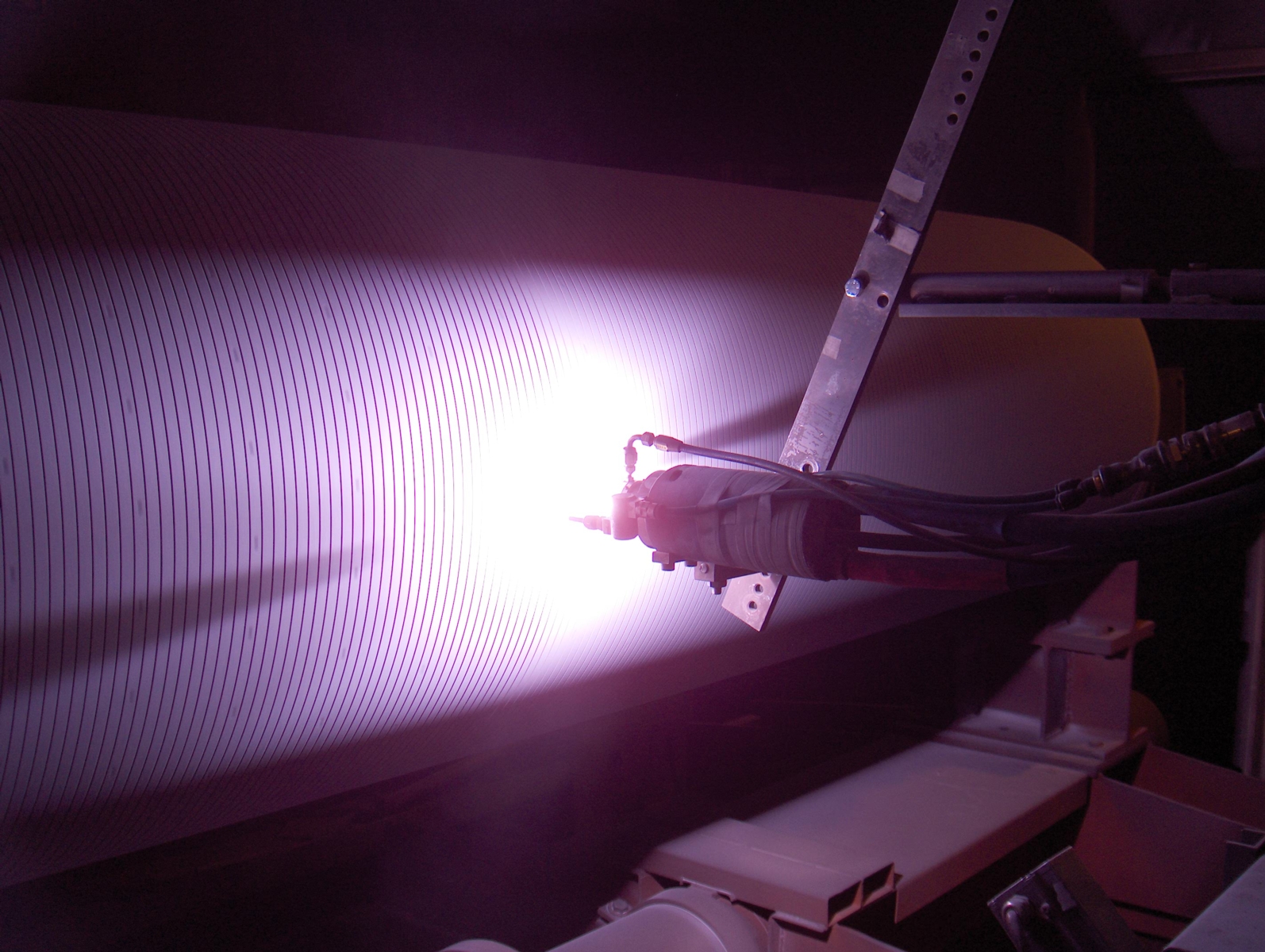
Thermal spraying is particularly useful when worn or damaged surfaces need to be restored with a robust repair coating. In this process, a coating material is melted or fused and applied to the prepared surface.
Depending on the material and process, coatings can be produced for wear protection, corrosion protection, dimensional correction, or functional surface properties. This makes thermal spraying an important technology for the reconditioning of high-quality industrial components.
Especially for expensive, hard-to-find, or heavily stressed components, a thermally sprayed repair coating can be a resource-efficient alternative to manufacturing new parts.
Wet Paint and Fluoropolymer Coatings for Non-Stick Properties and Chemical Resistance
Wet paint and fluoropolymer coatings are suitable for applications requiring non-stick properties, chemical resistance, corrosion protection, lubricity, or electrical insulation. They are used, among other things, when surfaces need to be easy to clean, when media must not adhere, or when components need to be protected against aggressive environments.
When repairing such coatings, the key factor is whether the existing layer is still structurally sound. If adhesion, layer structure, or surface function can no longer be reliably guaranteed, a complete recoating may be more sensible than a spot repair.
Particularly with PTFE-, PFA-, or FEP-based systems, repairs should therefore always be technically evaluated. The goal is not only to eliminate visible damage but also to permanently restore the desired function of the surface.
Have Your Coating Repaired by Buser Oberflächentechnik
Buser Oberflächentechnik AG supports customers from the initial assessment through to professional implementation. This includes component and damage analysis, consultation on the appropriate coating, surface pretreatment, application of the repair layer, and, if necessary, coordination of further processing steps.
Whether it’s wear protection, corrosion protection, non-stick properties, lubricity, or chemical resistance: Buser develops solutions tailored to the specific application. Repairing a coating can help extend the service life of existing components, improve equipment availability, and reduce costs compared to manufacturing new parts.
If you’d like to repair a damaged coating, apply a repair layer, or have a PTFE or Teflon coating repaired, we’d be happy to assess which solution makes the most technical and economic sense for your component.
FAQ: Frequently Asked Questions About Coating Repairs
Can a damaged coating be repaired?
Yes, many damaged coatings can be repaired or restored with a new repair layer. The key factors are the nature of the damage, the base material, the coating structure, and the subsequent stress the component will be subjected to.
When is it worth repairing a coating?
Repair is particularly worthwhile for high-quality, hard-to-replace, or large components. It can reduce costs, shorten downtime, and extend the component’s service life.
What is a repair coating?
A repair layer is a precisely applied coating used to restore damaged, worn, or functionally impaired surfaces. It can, for example, improve wear resistance, corrosion protection, or lubricity.
Can a Teflon coating be repaired?
A Teflon or PTFE coating can be repaired or rebuilt, depending on the extent of the damage. Often, complete removal and recoating is more practical than a spot repair.
Which coatings can be repaired?
Coatings that can be repaired include wear-resistant coatings, corrosion-resistant coatings, non-stick coatings, lubricating coatings, and functional surfaces. The appropriate solution always depends on the component and the application.
How is a coating repaired?
First, the damage is analyzed. Then the surface is cleaned, prepared, and, depending on the requirements, treated with a suitable repair layer or a new coating.
Is it possible to repair large components?
Yes, even large components can be coated or repaired. Depending on the component, the damage, and accessibility, the work can be performed at the factory or, in certain cases, on-site using mobile equipment.
Is a repaired coating as durable as a new coating?
That depends on the damage, the process, and the coating system. With proper preparation and the right choice of coating, a repaired surface can once again be durable and fully functional.